
Our Story
A ruin above the fjord, brought back to life by one family, not restored into something new, but brought to be itself again.
The Origins
Where the sea was once a threat, not a promise
Long before this villa existed, there was only the sea and the fear of the sea. Along the Amalfi Coast, for centuries, the horizon was not a promise of beauty but a threat: from the water came the pirates, the invaders, those who arrived to plunder and to burn. And so, with the ancient instinct of those who have something to protect, the noble families learned to build high, perched upon the hills, where the eye could run far and catch danger in time.
Below, clinging to the rocks and to the level of the water, remained the houses of the fishermen: small, plain, inhabited by people who owned nothing and therefore feared losing nothing. This is the invisible geography of the coast, the lords upon the heights, the humble upon the sea, and it is within this geography that, around the seventeenth century, some three hundred and fifty meters above the sea, Villa Divino Maniero was born.
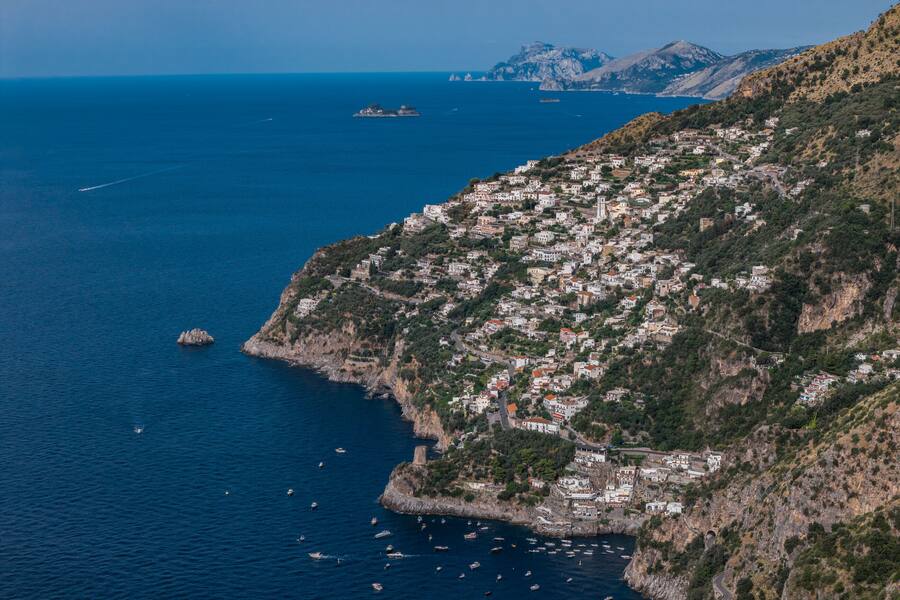
The Amalfi Coast: the lords upon the heights, the humble upon the sea.
The Divine Keep
Maniero and Divino: the two souls of a name
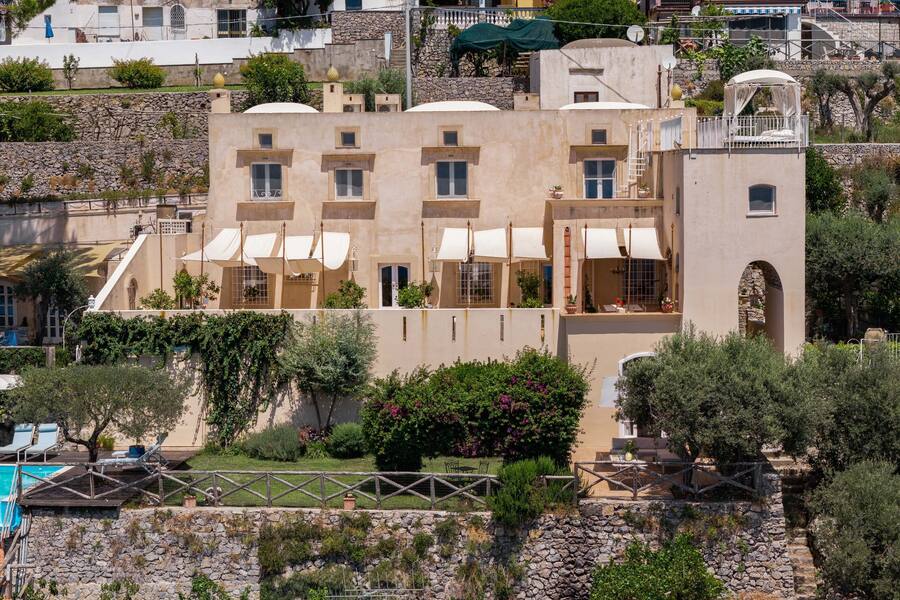
Villa Divino Maniero carries two souls in its name. The keep, the maniero, because this was never a simple house but a small fortress: the residence of a wealthy landowner, defended by mighty walls that still reveal all their strength to anyone who looks out from the terrace where the pool now rests. And the divino, because from such a height, suspended above the water, one truly feels one is dwelling on the Olympus of the gods, and because this stretch of coast, beloved of the Grand Tour travelers and of the jet set of every age, was once called the Costa Diva, the divine coast.
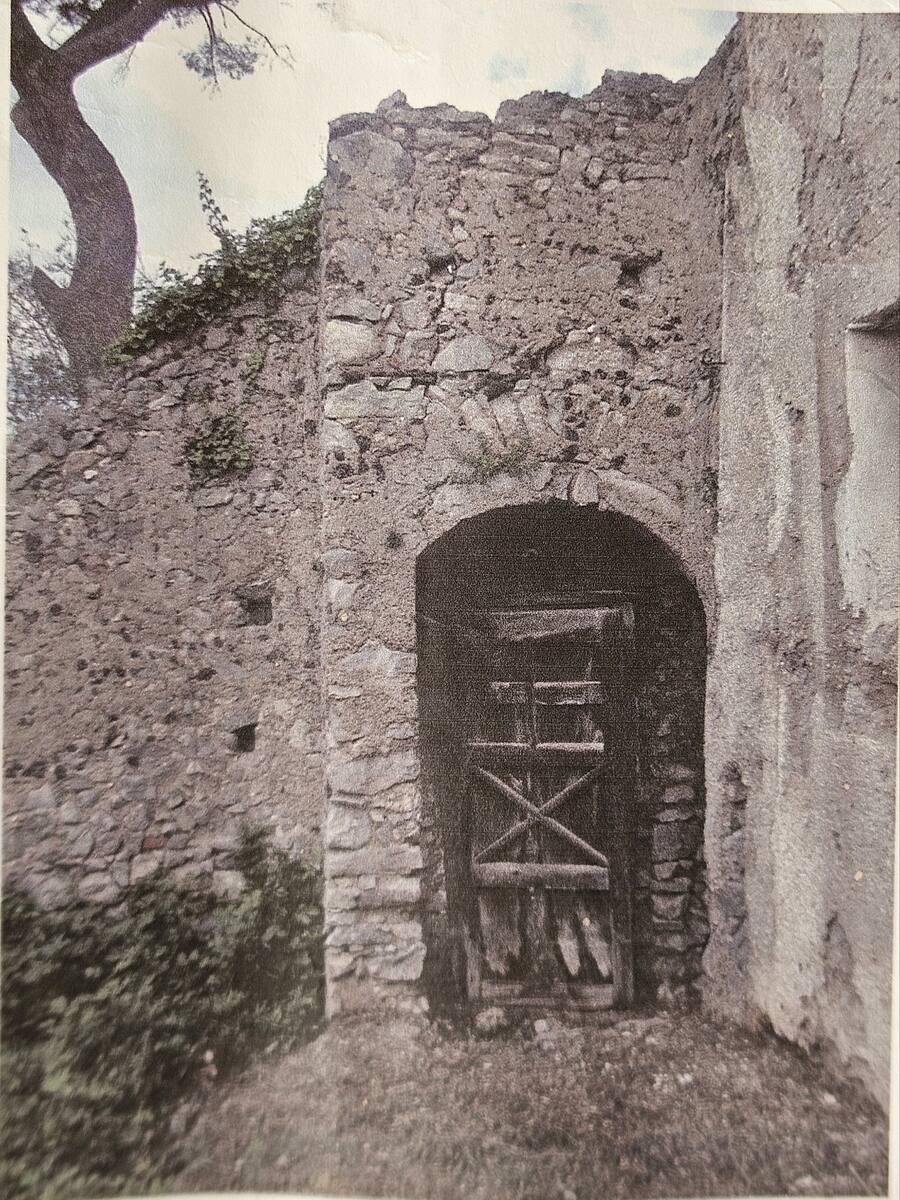
Whoever enters the villa today walks within that defensive vocation, which has remained intact. There are the loopholes, narrow openings from which the guards once kept watch over every entrance. There are the fortified doors, barred by mechanisms of ancient bronze and carved with crosses of reinforcement, so solemn that they recall the drawbridges of medieval castles; one of them was even turned into the table of one of the kitchens, yesterday a defense and today a place of gathering. And there is, at the highest point of the house, the watchtower that once commanded the sea; today it holds, within its stone, the bathroom of the master suite.
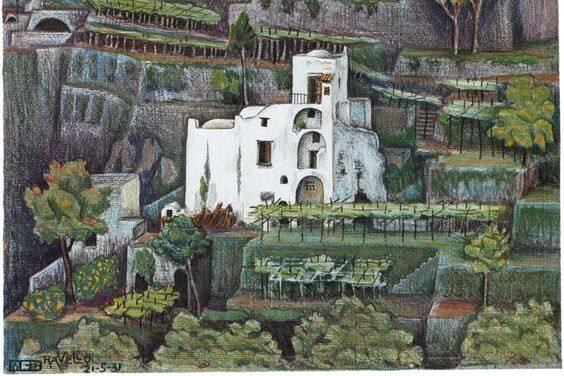
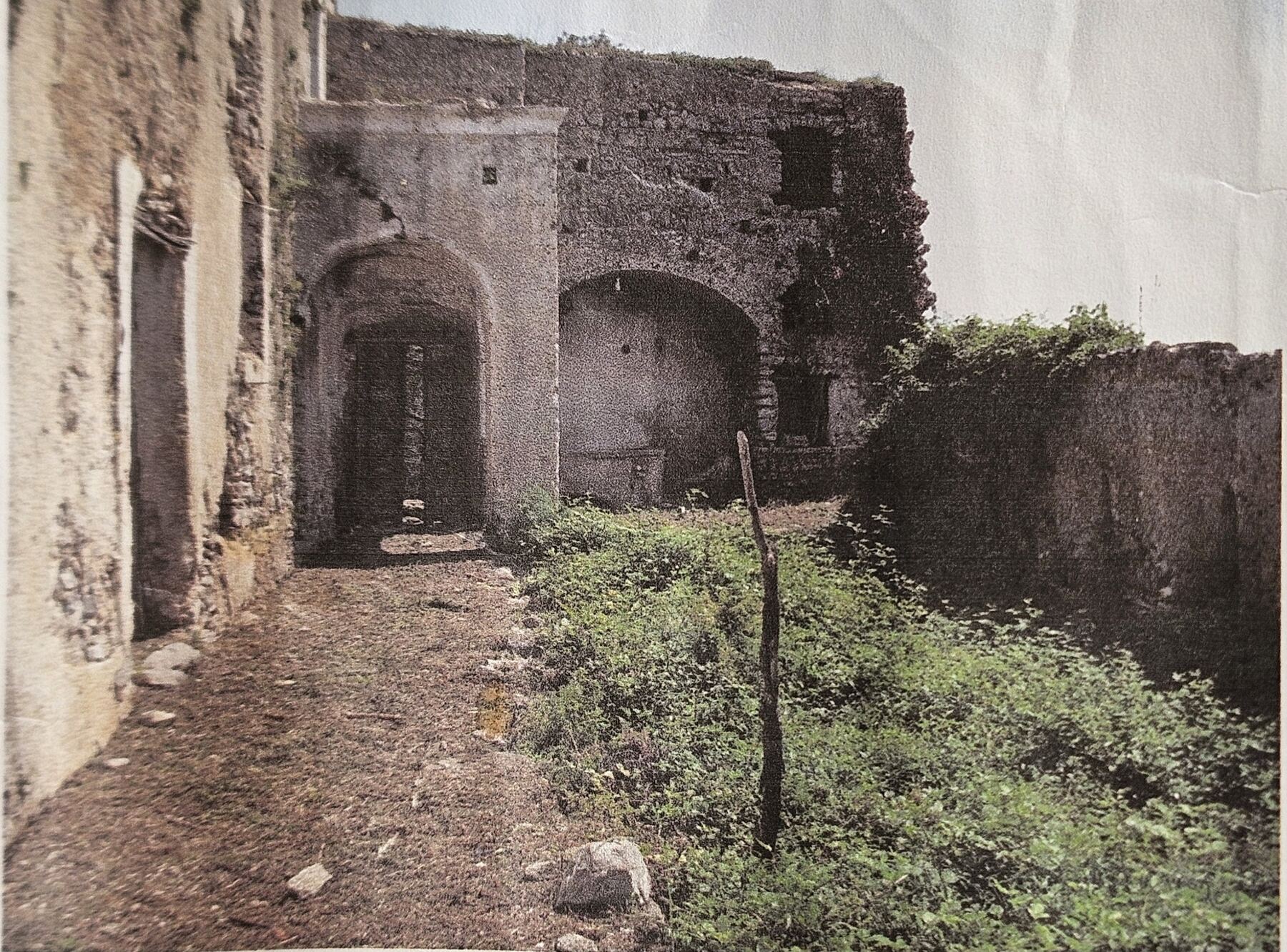
The fortified house, still standing today, and an Escher depiction of a house on the Amalfi Coast.
The House Through the Centuries
An echo of the East, kept alive within these walls
Amalfi, after all, was not only a land to be defended: it was one of the four Maritime Republics, and its men, navigators as skilled as the Venetians, drove their sails as far as the Far East. They returned with their holds full of spices and silks, and with them they brought home the taste and the forms of distant worlds. That echo of the East still lives, discreetly, within these walls: in the Byzantine cross that marks the doors and resurfaces in the vaults above the stairs, in the fabrics and the motifs that once adorned the drawing rooms of the lords.
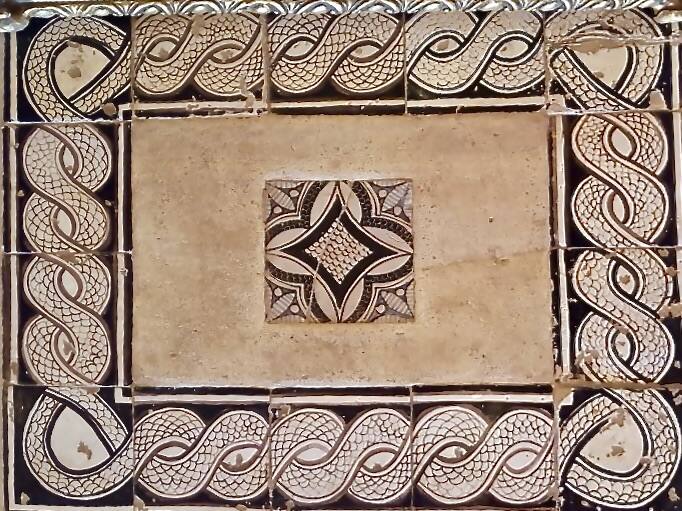
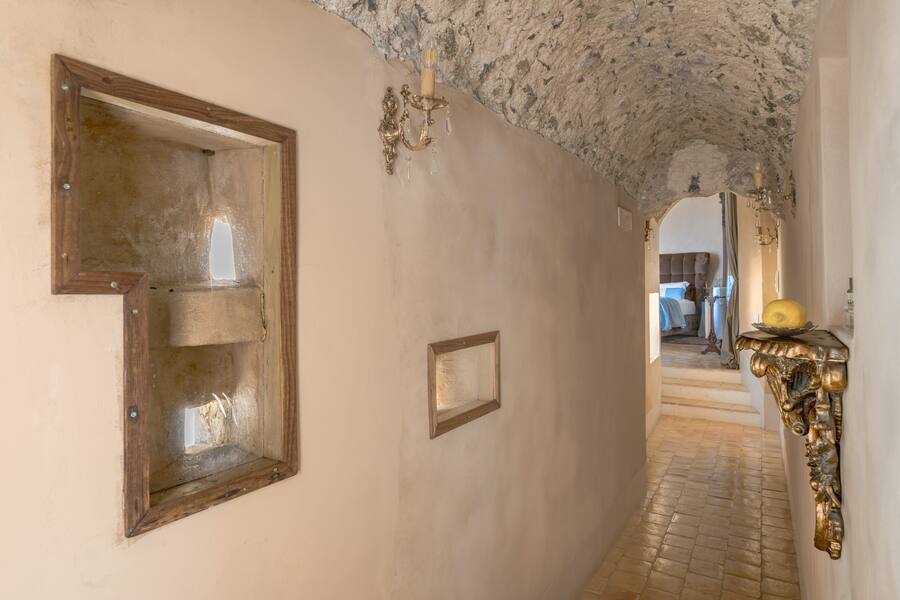
Unlike the fishermen's dwellings, tiny cubes with an outer stair that climbed to the lofts of winter provisions, the villa unfolds over two floors, stitched together by an internal staircase of rare elegance for its time. The steps are still the original ones: we chose to preserve even the joints worked by hand by the local artisans, because we wish to keep the story of this house alive in just this way, tending every object without ever betraying its soul. And in every room time has left a token: the Louis Philippe wardrobe from the mid nineteenth century, the plate rack of the Neapolitan craftsmen, the gold-leaf chandeliers beaten by the artists of the place, the Venetian console in one of the bathrooms, and the eighteenth-century majolica of the master Giustiniani, its dark geometric knotwork bordering a small central star.
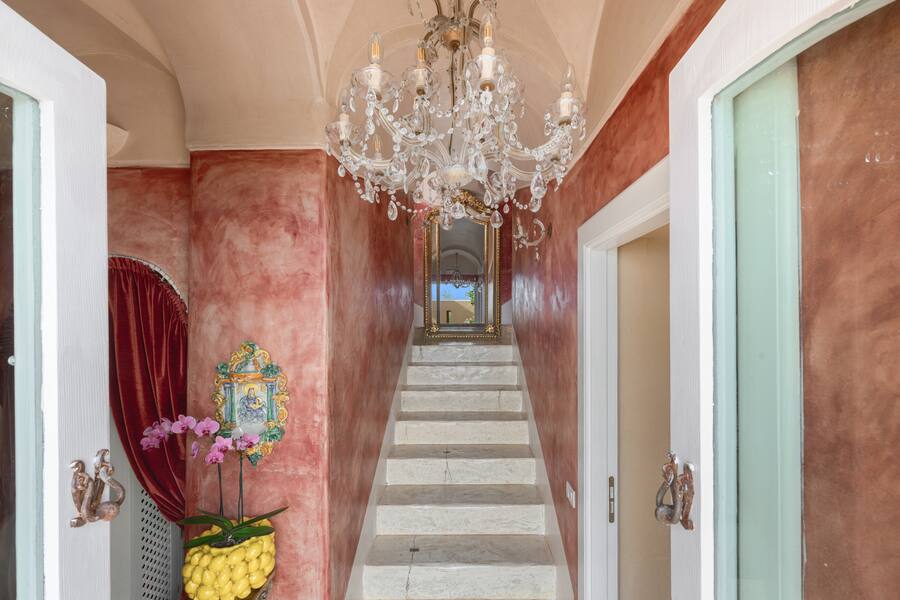
The interior staircase: original steps, hand-worked joints, unchanged since the villa's earliest days.
A Life Upon the Land
The oven, the terraces, and a house sufficient unto itself
To be lords, here, meant above all to live off the land, and the land, around the villa, has always been a generous mother. The terraces drop sheer to the sea, planted with lemons and olives, and their fruits remain to this day the delight of all who arrive. From the olive comes, by cold pressing, that oil the Mediterranean has always held to be an elixir of long life; from the lemons come cordials, distillates, fragrant infusions, a whole history that would deserve a tale all its own.
The villa was a small world sufficient unto itself. In the courtyard the hens scratched about, giving eggs and sustenance; in the stables, there where the orangerie now opens, the cows and the goats offered the milk from which were born, and are born still, mozzarella, goat cheeses and the famous provolone del Monaco. The mules, patient, climbed and descended the vertical stairways that, flight by flight, joined the sea to the mountain: it was they who carried into the house the spices and silks landed by the trading ships, in a village like Furore made entirely of hairpin bends sheer above the water.
And at the center of everything the oven kept watch. Bread-making was a rite: it was done as seldom as once a week, and fortunate was the family that owned an oven like this one. The bread was born slowly, from the hands of the mothers and from the mother yeast, that living morsel, refreshed each day, handed down from generation to generation like a silent inheritance.
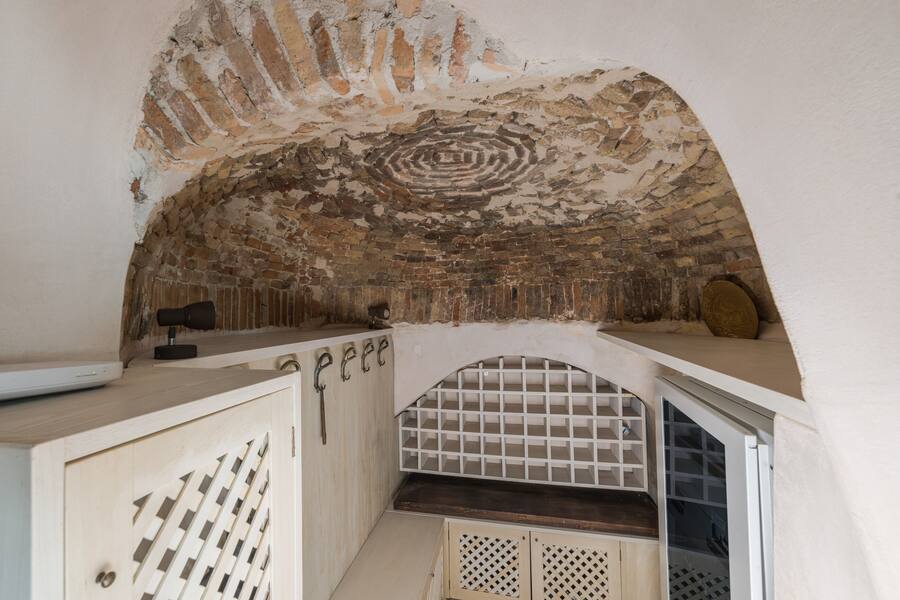
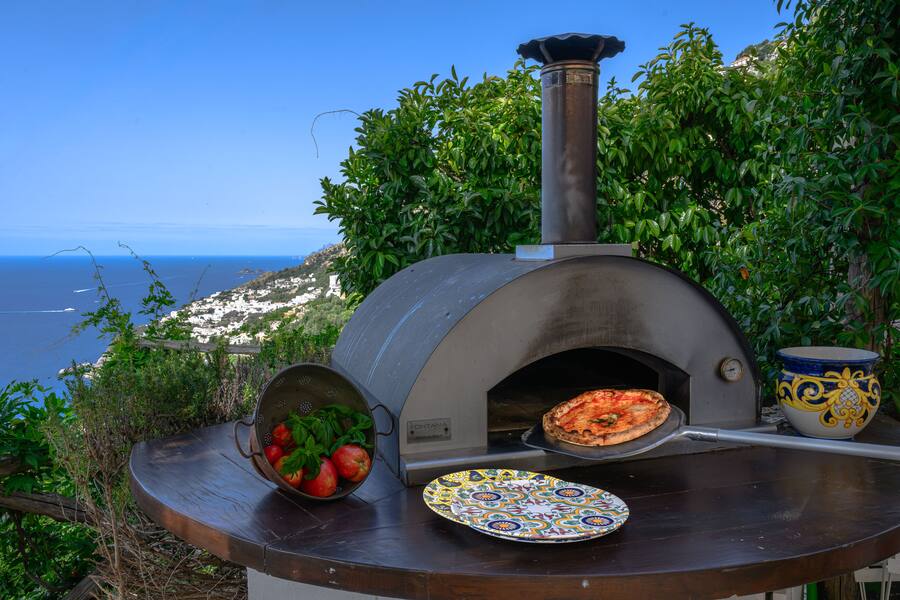
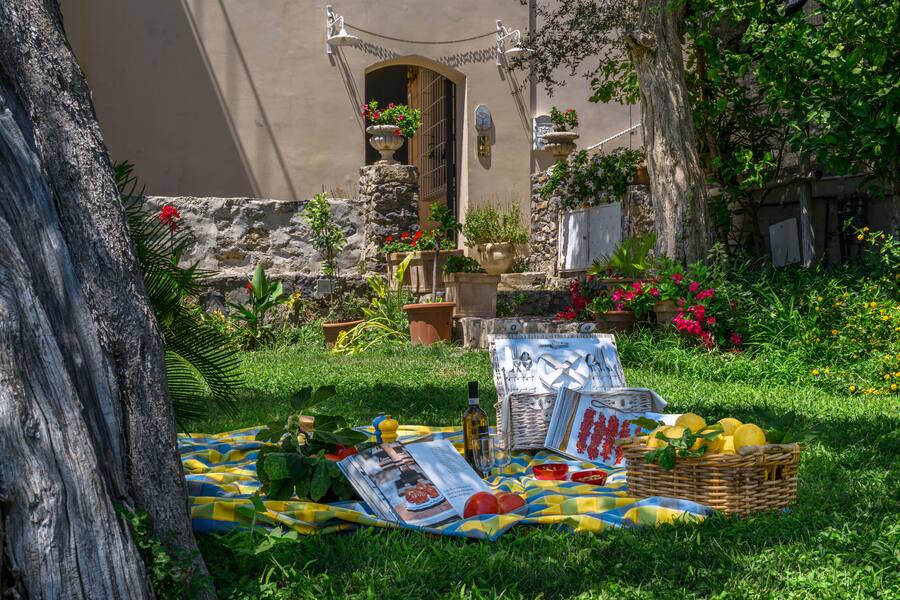
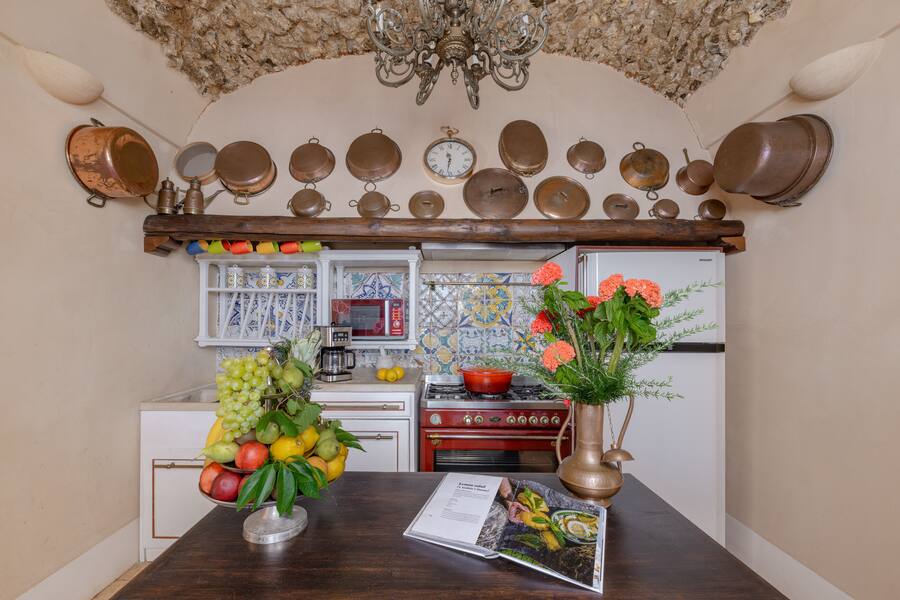
The old oven, and the oven today; a garden picnic, and the old kitchen, still in use.
The Sea of Ulysses and the Voices of the Night
Where the sirens sang, and the stars still burn undimmed
From this height the gaze embraces Capri and its sea stacks, and the archipelago of the Sirenuse, where the Homeric tradition placed the sirens. It was in these very waters that Ulysses, in the Odyssey, to resist that irresistible song had himself bound to the mast of his ship: whoever listened, spellbound, would cast himself among the waves to reach it and there would meet his end. It is the same sea that, from the villa, we go on sailing with our eyes.
And then there is the night. Far from the lights of crowded tourism, here the sky recovers its ancient purity, and the stars return to shine as once they shone. With the darkness the tales of Furore resurface as well: the janare, the witches who came on nights of wind; the devil who tried to settle in this village but had to flee, stung by a wild herb, defeated by the very harshness of the place. Furore bears this name precisely for the fervor with which nature shows itself. And it is that same nature that offers, among the rocks, its generous herbs: the wild fennel of the liqueur and of the taralli, the rosemary of the infusions, the wild mint, a spontaneous garden that perfumes our own as well.
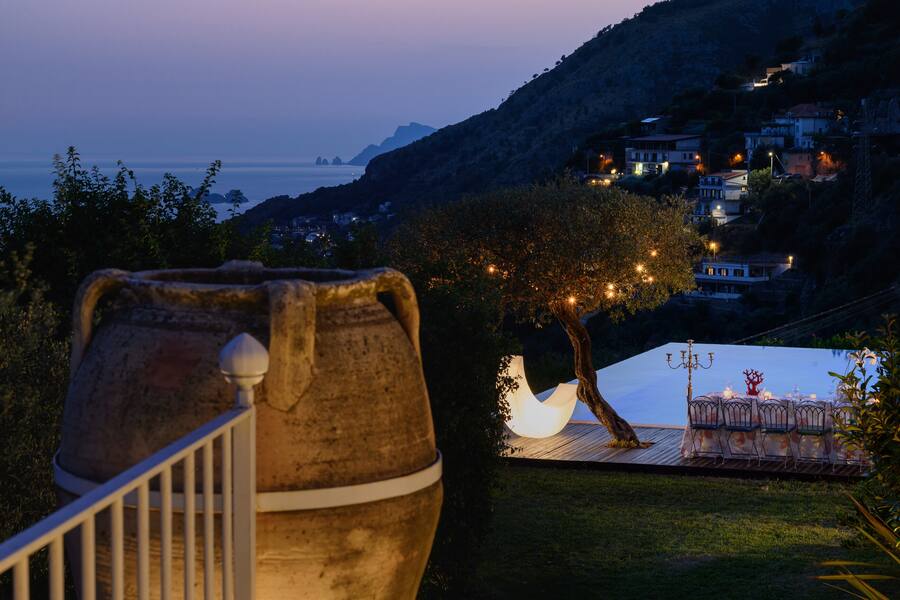
Capri by night, seen from the villa: the same sea Ulysses once sailed.
La Dolce Vita, Today
An ancient art of living, offered to whoever knows how to seek it
Standing guard over the villa watches an ancient maritime pine, a heritage of humankind: towering, with an imposing trunk, it shades the house, cools it, perfumes it. From its cones we gather the pine nuts of the pesto, but it is above all the incense they release in the sun, and the song of the cicadas that inhabit them, that compose the soundtrack of the summer evenings. It is here, beneath this canopy, that the past hands the baton to the present. For all that this house has been, fortress, farmstead, refuge, today it resolves into a single phrase: la dolce vita.
But what is it, truly? It is not idleness, and it is not luxury for its own sake. It is an ancient art of living, wholly Mediterranean: the art of slowing down, of letting time, and not the clock, set the measure of the days. It is waking with the light and resting with the dark; it is sitting at the table before real food, genuine, grown a few steps away; it is granting oneself the wonder of a gaze that loses itself in the infinite, from every corner of the house or from the edge of the infinity pool, heated and purified with sea salt. It is walking barefoot on the grass, embracing the old pine, breathing scents that are authentic and not synthetic.
Villa Divino Maniero is not merely a home. It is la dolce vita, kept and offered to whoever knows how to seek it.
Science has proven it right, less stress, a clearer mind, a body more at ease, and it has revealed one further gift: slowing down kindles creativity. It is no accident, then, that from this industrious slowness bloomed the arts and crafts that still distinguish the coast. It is in the dilated time of la dolce vita that hands learned to carve wood, to work paper, to paint and to shape ceramics: beauty here has never been haste, but the patient fruit of a free mind.
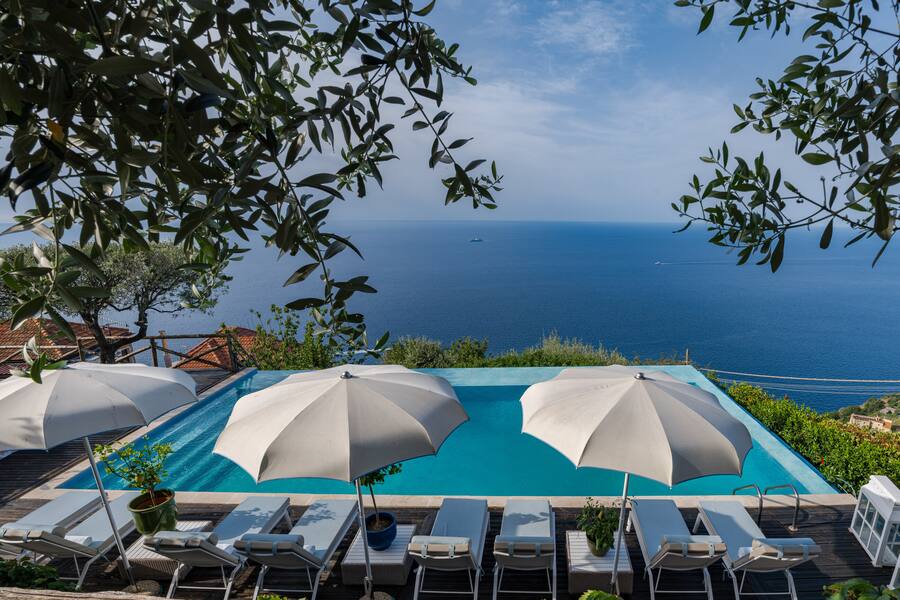
The villa today: the past, kept alive as a way of living, not a memory to visit.

Breakfast for two, beneath the wisteria, with the sea beyond.
The Restoration
Bringing a ruin back to life, one mule-load at a time
The restoration began in 2007 and, in a sense, has never really stopped. It was guided throughout by one principle: respect for the genius loci. Every room and every original feature was preserved, and where a material no longer survived, we sought one true to the period, always natural. The old logic held too: working rooms on the ground floor, the lord's rooms above, an order the house still keeps today. Antique markets supplied period pieces, among them the Neapolitan and Giustiniani majolica on the staircase.
It was, and remains, a family undertaking. The property has no road access, the same isolation that gives it its privacy, so every load of material had to rise by mule, a few hours a day and a limited weight each time. That is why the work took so many years, and why parts of it continue still. It leaned on master masons who knew exactly which stone a vault could spare, a mountain carpenter behind every piece of boiserie and window frame, upholsterers reviving old silks, and a gardener who tracked down and replanted the estate's original aromatic herbs.
Some places are not simply owned. They are imagined, cared for, slowly transformed… stone by stone, we watched the house come back to life day by day, almost as if it were a living creature: wanted, tended, loved.
The same respect runs through the smallest details: a plaster made from crushed local rock, mirroring the color of the mountains; the old wash basin and well, restored rather than replaced, one of the well's cisterns now a room in its own right; and the infinity pool, carved into the natural drop of the terracing rather than imposed upon it.
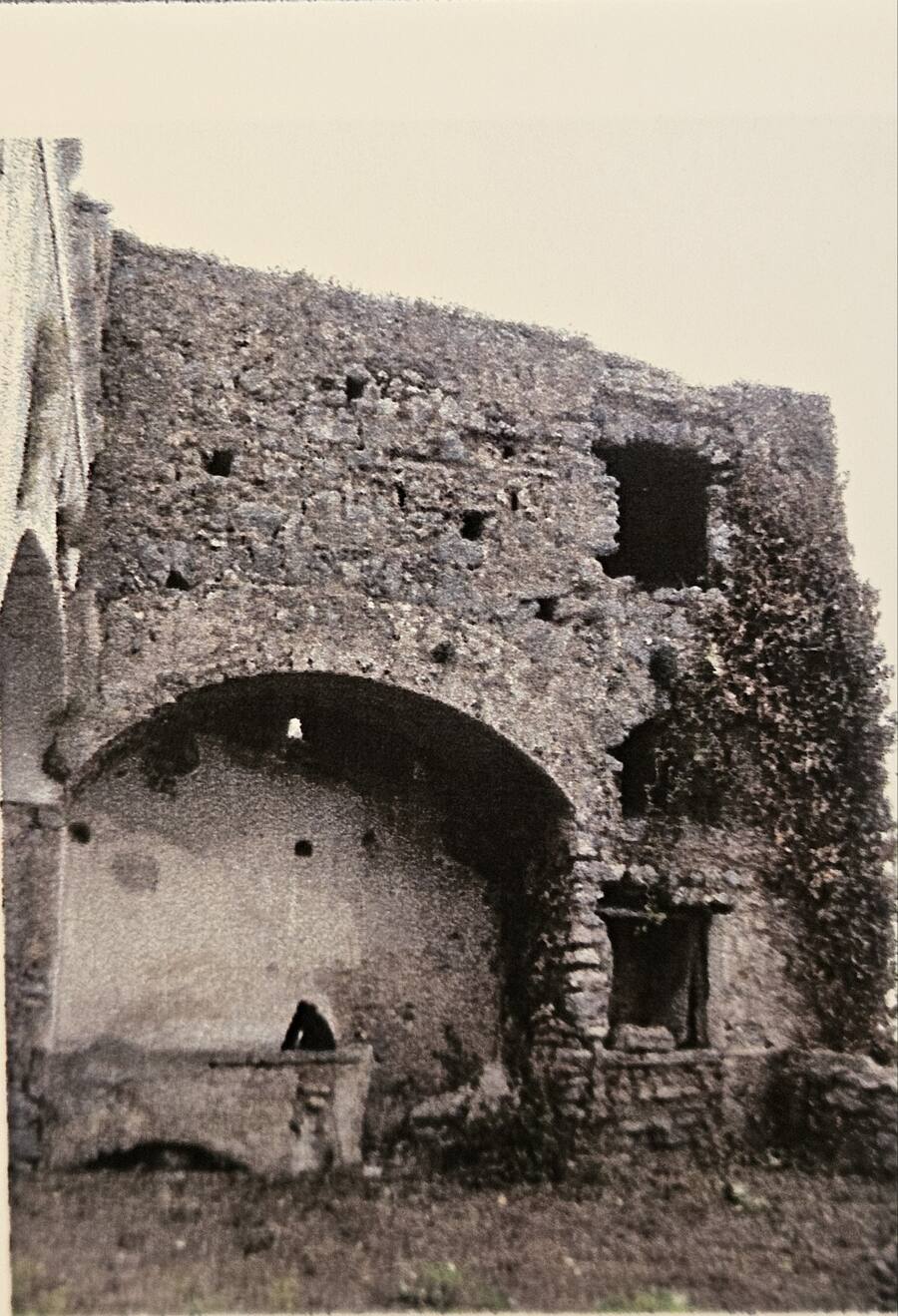
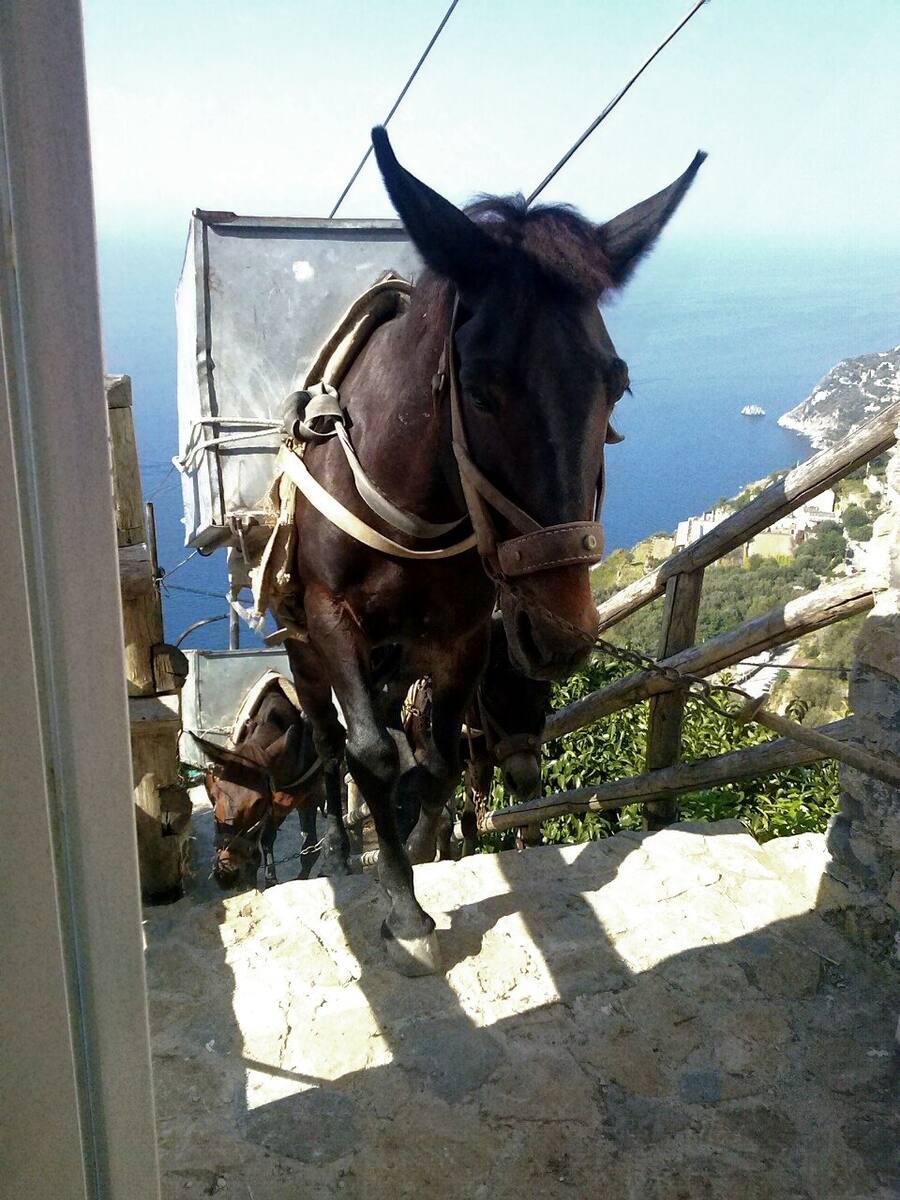
The well before restoration, and the mules that carried every load up.
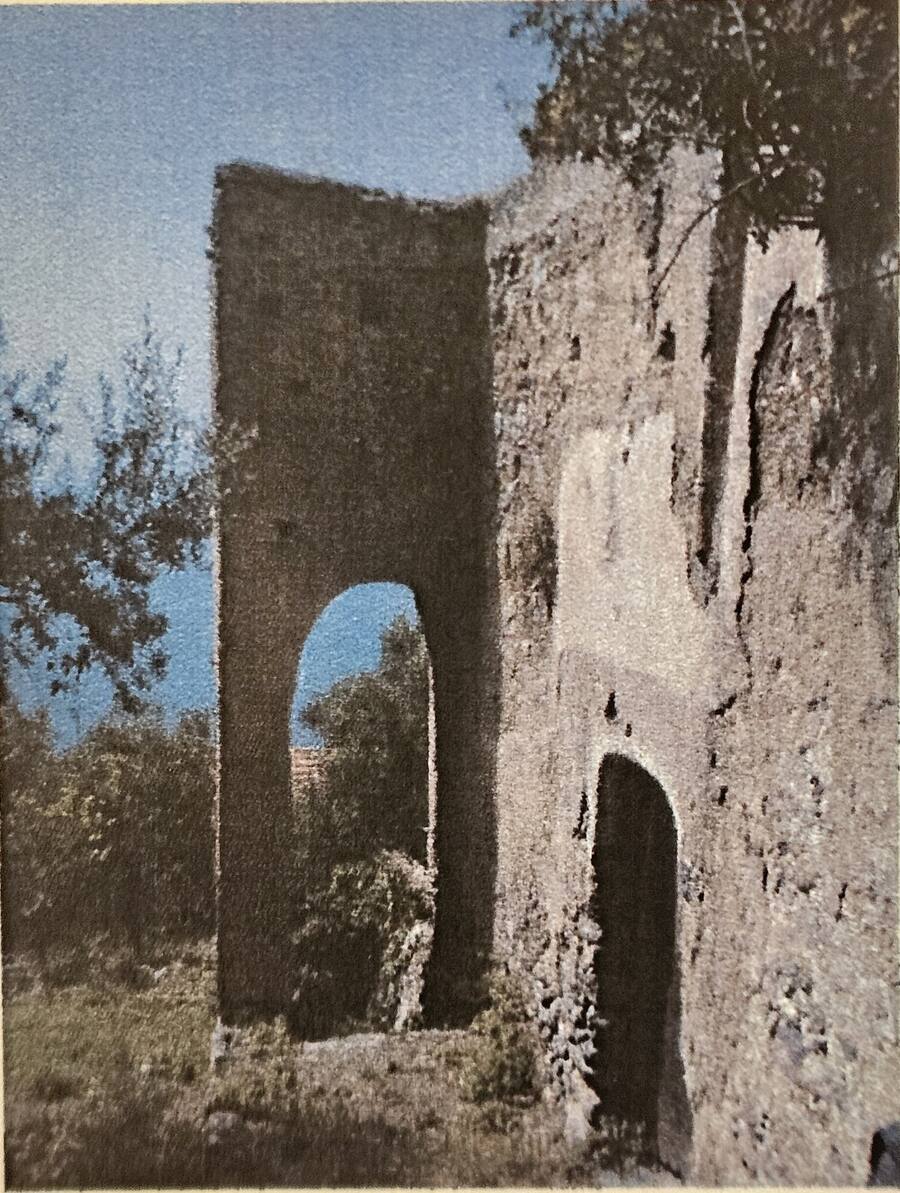
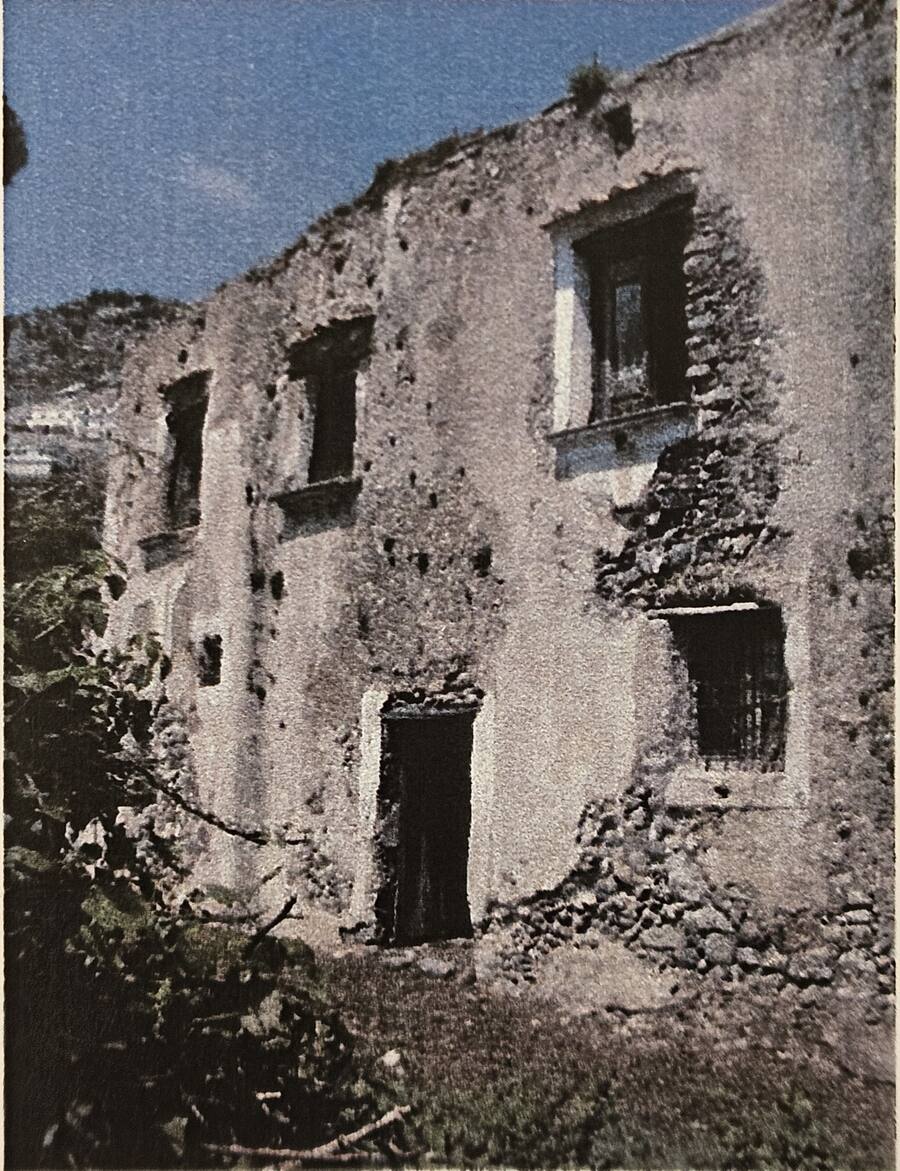
The ancient tower and the old house.
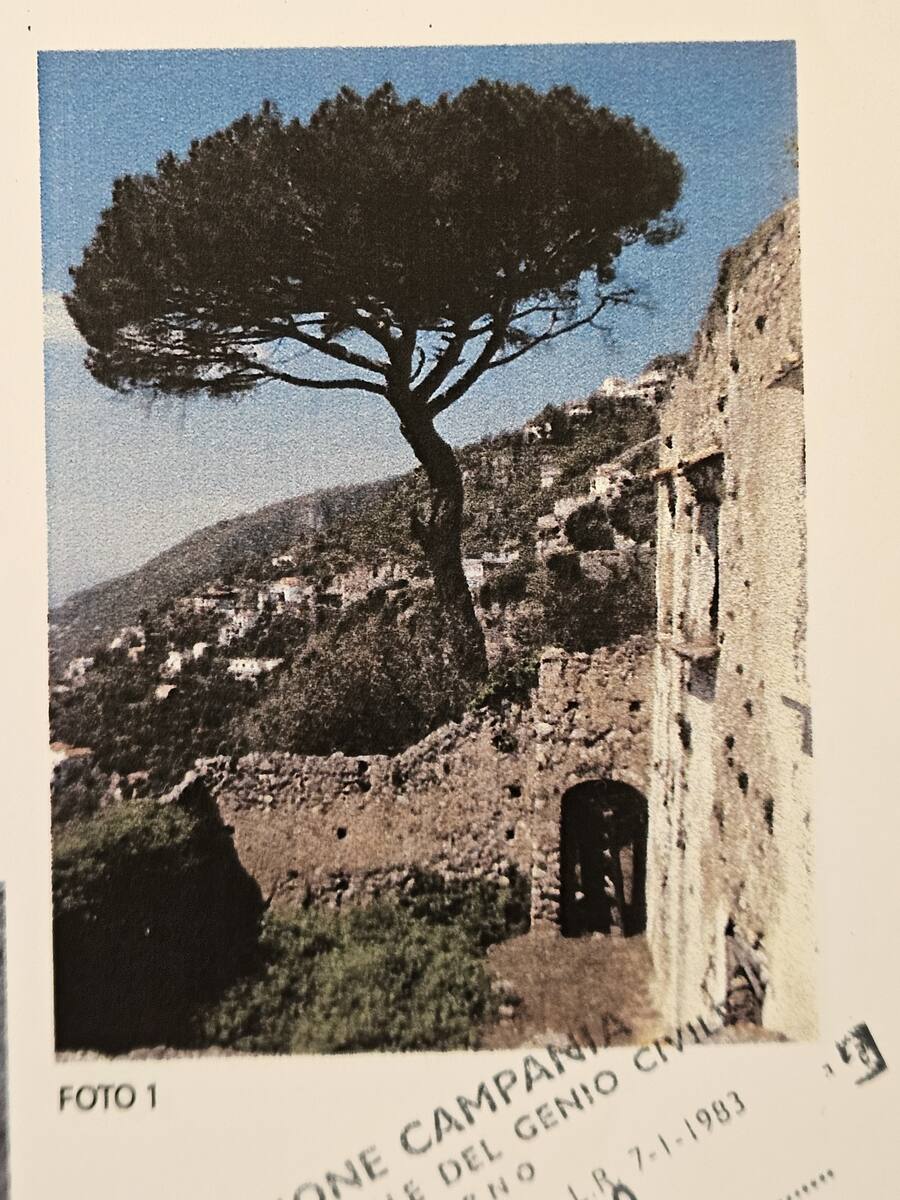
The old maritime pine, standing guard over the house.